

Empty nest decluttering is different from the kind of decluttering you may have done in earlier seasons of life, and treating it like a regular weekend purge is one of the main reasons most people stall out before they make any real progress.
There’s a unique type of overwhelm that hits when you’re standing in the middle of your empty nester home, staring at decades of accumulated family life with absolutely no idea where to begin. If you’ve landed here after reading about the signs it’s time to declutter your empty nest, you already know something needs to happen. Now you need to know how.
This post is the practical starting point you’ve been looking for…
This post may contain affiliate links. If you choose to purchase through an affiliate link, I may receive a small commission at no additional cost to you. This post is not to be taken as professional medical or mental health advice. All statements are strictly my personal life observations. You can see my full disclaimer here.
First, Understand Why Decluttering an Empty Nest Is Different
Before you start sorting even a single item, it helps to understand what you’re actually dealing with, because empty nest decluttering is not just a bigger version of cleaning out a junk drawer.
You’re working through years and years of accumulated family life. You’re making decisions about items tied to people you love and seasons of life that meant something to you. You may be navigating a partner who’s not at the same place you are. You are almost certainly dealing with a volume of stuff that didn’t get there overnight and won’t disappear in an afternoon.
None of that makes this undoable. It just means you need an approach that accounts for the real weight of working through this part of the empty nest transition… practically and emotionally. The tips in this post are built with that reality in mind.
Please remember, I’m writing this from the perspective of my own experience. I am NOT any type of counselor, so the things you read here may not apply to you, or they may need to be adjusted for your situation. Please take what you can use, discard the rest, and seek professional help if you feel it’s necessary.
That said, here are my recommendations for where to start.
Get Clear on What You Want This Chapter to Look Like
Most people skip this step entirely and go straight to sorting. I really think that’s a mistake.
Before you DO anything, take a few minutes to think about what you actually want your home to feel like now. Not what it looked like ten years ago. Not what it should look like according to someone else’s vision of the perfect empty nest lifestyle.
- What do you want more of in your daily life… space, calm, ease, room to breathe?
- What do you want less of… obligation, maintenance, the low-grade mental drain of too much stuff competing for your attention?
This doesn’t need to be a formal exercise. Of course you can do some journaling or list-making if it helps, but It can be as simple as sitting with those two questions and letting yourself answer them quickly and honestly.
Either way, having that clarity before you start making decisions about individual items gives the whole process direction. Without it, you’ll end up doing more indecisive sorting… and that’s what leads to reorganizing the same clutter rather than actually removing it.
Your answers could come from the angle of wanting to stay in your home and making it ready for future years, or you could be looking at this from the viewpoint of downsizing or moving to a completely new area. It really doesn’t matter, because you still need to know what you want to actually start making it happen.
Now for the practical work…
8 How-To Decluttering Tips for Your Empty Nest
These empty nest decluttering tips are ordered deliberately… the earlier ones build the foundation that makes the later ones easier.
1. Start with the area you most want to reclaim.
For clearing out your empty nest specifically, starting with the area that means the most to you — and will quickly improve everyday life in your current season — tends to work best. The payoff is immediate and positive, and that’s what keeps you going when the process gets harder later.
Ask yourself two questions:
- Which room reminds you most that this chapter of your life has changed?
- Which space do you most want to reclaim for yourself?
The answer to one or both of those questions is where you start.
For most empty nesters, that points directly to a former kids’ room that never got a second act, a basement that became the final resting place for everything without a home, or an area you’ve been mentally redesigning for years but never actually cleared out so you could actually get started.
These are the spaces that carry the most personal significance, and clearing even part of one creates exactly the kind of shift that makes the whole process feel worthwhile.
The goal at this stage is not necessarily efficiency. It’s more about building momentum and skills. Start where it matters most to you, and the rest of the house becomes easier to face.
2. Use the 10 items or 10 minutes rule every. single. day.
This is the tip that sounds too simple to work until you actually try it consistently.
Every day, remove 10 items from your home or spend 10 focused minutes decluttering. That’s it. No marathon sessions, no entire Saturdays sacrificed to the process. (Okay, there is one exception to this, but we’ll get to that later.)
The reason this works so well for empty nest decluttering specifically is because it reduces decision fatigue AND physical fatigue. Making choices about items tied to family memories takes more mental energy than deciding whether to keep a spatula… and that energy runs out faster than most people expect. Plus, moving things around gets harder and our bodies tire more easily as we get older
Ten items or ten minutes is a low enough threshold to show up for even on your tired days, and consistent small sessions add up to real, visible progress over time.
A running count of items removed is a powerful motivator here. The numbers accumulate faster than you expect, and on the days when a room doesn’t look noticeably different yet, that total reminds you that you did do something. You can also take pictures to help you track the visual progress.
3. Have some basic rules and a decision-making framework.
One of the main reasons clearing clutter quickly stalls is when you’re holding every item for four minutes without knowing what to do with it. Decision fatigue sets in fast when every object requires a fresh debate about all.the.things.
The fix is to have your requirement for keeping something very clear before you start. This becomes a simple set of questions you run every questionable item through very quickly so the decision is made by the framework.
Good questions for this stage of life include:
- Do I love this enough to maintain it?
- Does this belong to a season of life that has already ended?
- Does this item need repair?
- Would I pack this if I were moving to the home I actually want?
- Could I borrow or replace this if I genuinely needed it someday?
- Am I keeping this for an adult child who has never asked for it?
If the honest answers point toward letting it go, let it go. Don’t overthink this part and debate donating vs selling, or which relative should get each item you don’t want any longer.
Make it simple. Donate.
If friends or family members wanted any of your stuff, they would have already told you. Don’t put them on the spot by asking them now about random things. And if you ARE holding things for adult children who have expressed a desire for those items, give the things to them.
Along with that, don’t put yourself in the position of holding your clutter for who knows how long while you spend time and effort trying to sell it. If you TRULY believe your things are valuable but you don’t wish to keep them, you should contact an appraiser or an auction service. But don’t be surprised if those things aren’t worth what you think.
Honest answers and eliminating some decisions altogether are a couple of the most effective declutter strategies available.
Related: Where to Donate Your Stuff After Decluttering
4. Deal with your adult kids’ belongings separately.
This category deserves its own approach because it is genuinely different from decluttering your own things. Plus, it’s sometimes the exception to the ‘10 items or 10 minutes’ rule. Here’s why…
The items your kids left behind are not yours to manage indefinitely. Contact them, give a clear and reasonable deadline to come and take care of their stuff — somewhere between 30 and 90 days depending on your circumstances.
Here’s the thing… you need to follow through when that deadline arrives. Items they choose not to retrieve by then are yours to handle as you see fit.
This isn’t harsh. It’s respectful to both of you. They get a fair opportunity to make a decision, and you get your space back. The alternative — holding space indefinitely for belongings that belong to adults who have their own homes — is how basements and entire rooms stay frozen in a previous decade.
This is fresh on my mind since we just did a deep declutter of my older son’s room when he was here for a few days in December. Confession… It’s been over three years since he moved out permanently. I had NO IDEA how much was left in his closets until my husband and I decided it was time to remodel the room and we started looking around in there.
My son spent an entire day decluttering that space. Honestly, I didn’t even offer to handle any of it. I was in there for a few hours to help move things around, put items in trash bags as he made decisions, etc.
He did most of the mental work and running up and down the stairs, but I was still physically exhausted for several days afterward. That is EXACTLY why I usually recommend slow decluttering, but sometimes you have to grab the opportunity to get the project done quickly when the timing is right for everyone.
A frank ‘this is your stuff to take care of’ conversation with your grown kids with a clear timeline is one of the most practical tips in this entire post. Don’t skip it.
5. Get donations out of the house immediately.
A donation box sitting in your hallway for three weeks is not a decluttering win… it’s just clutter in a container.
The physical act of removal is a non-negotiable part of the process. The moment a box is full, it goes in the car. And the car goes to the donation center ASAP. Items that stay in the house have an uncanny ability to find their way back into drawers and closets, especially when the emotional layer is involved.
This is one of those decluttering tips that feels obvious until you realize how many people don’t even think about it… and then wonder why their home doesn’t feel any different despite all the sorting they’ve done.
6. Stop bringing new things in while you’re actively decluttering.
This one is straightforward, but it is easy to overlook when you are focused on what is leaving.
You cannot make real progress on empty nest decluttering if you’re adding to the problem at the same time. A temporary pause on non-essential purchases while the process is active makes a measurable difference in how quickly you see results… and in how much mental space you have for the actual decisions in front of you.
‘Live simply’ isn’t just a philosophy. During an active decluttering season, it’s a practical choice that allows for more progress and will help you keep enjoying your empty nest lifestyle as the years progress.
7. Know your pace and protect it.
Some people can declutter for two focused hours at a stretch. Others hit a wall after ten minutes, especially when the emotional layer is present. Both are completely normal.
The mistake is getting into a cycle of pushing past your actual limit until you’re overwhelmed enough to quit for a month. Consistent short sessions beat sporadic marathon sessions every time for this kind of work. Know where your limit is and build your sessions around it.
8. Leave the sentimental items for last.
This isn’t avoidance. It’s strategy, and it’s important.
Sentimental items require the most decision-making energy of anything in your home. If you start there, you’ll burn out before you’ve built the decision-making skills and the momentum that makes those decisions easier.
Work through the straightforward stuff first. The most current clutter. Clothes that haven’t fit in five years. Broken things you kept meaning to fix. Each easy decision you make builds your capacity for the harder ones.
By the time you reach the memory boxes, the kids’ childhood artwork, and the items tied to specific people and moments, you’ll have both experience and momentum behind you. I’m not saying it won’t be difficult. But it will be easier when you’re already in the decluttering mindset.
I’ve written about working through sentimental clutter in more depth. it’s worth reading before you get to that stage so you have a plan rather than just hoping the emotions cooperate on any given day.
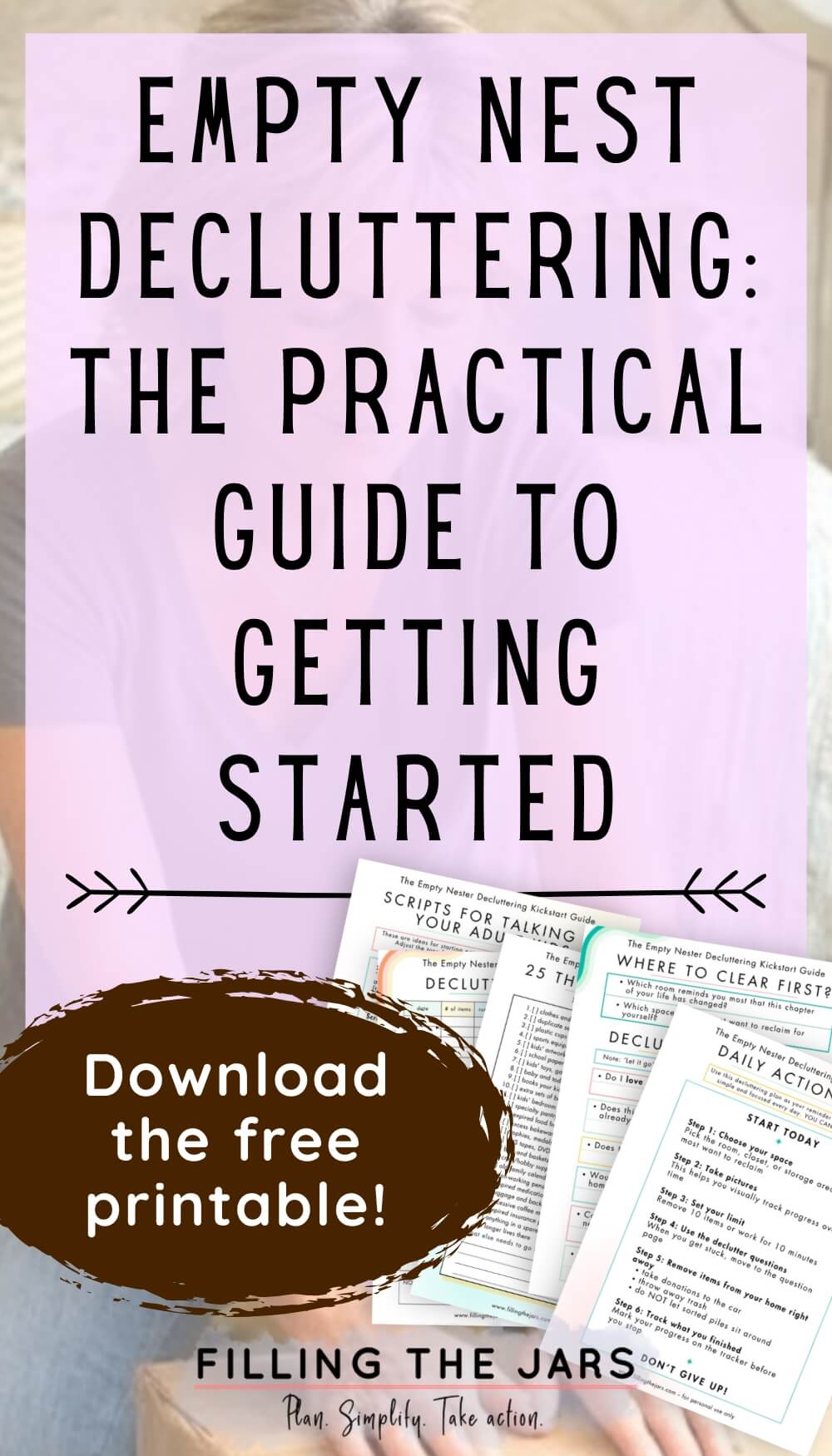
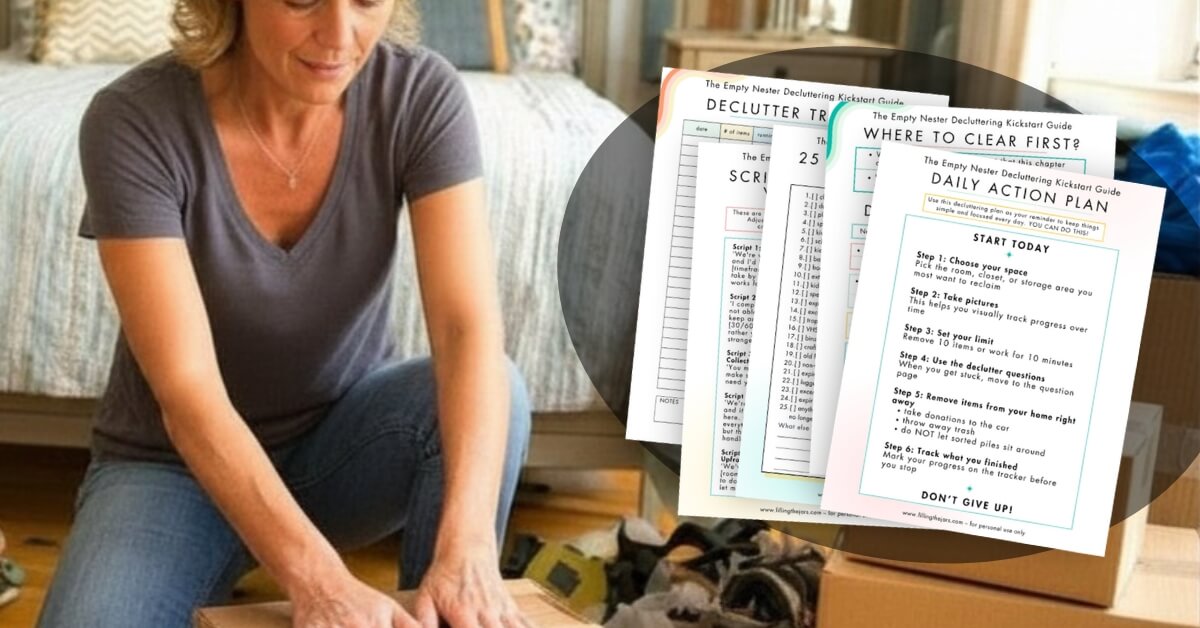
Having a ready-to-use starter system makes a real difference. The Empty Nester Decluttering Kickstart Guide gives you a printable daily action plan, a set of decision-making questions built for this stage of life, a 25-item quick-start checklist of things you can remove without second-guessing yourself, a tracking sheet to keep your momentum going, and conversation scripts for talking to your adult kids about their stuff. Exactly what you need to stop thinking about it and actually start.
There is something I want you to remember…
The Emotional Layer Is Part of the Process
Empty nest decluttering will surface feelings that go beyond the practical work of sorting and removing. You may find yourself unexpectedly emotional over items you thought you didn’t care about. You may feel a grief for a season you loved even as you’re also ready to move forward from it. You may feel resistance that you cannot fully explain.
That is not a problem. It’s part of the process for most people moving through this particular life transition… and it doesn’t mean something is wrong with you or that you’re doing this incorrectly.
What it does mean is that your pace matters, your self-awareness matters, and having a clear framework for decisions matters… because emotions fluctuate, and good declutter strategies should hold fairly steady even when your feelings might not. Most people are able to move through this layer, especially when they have small daily actions to anchor them and visible progress to point to.
If you find yourself consistently unable to move forward even with a clear plan in place, that’s worth paying attention to and possibly talking through with someone you trust.
More Decluttering Inspiration
How I Decluttered My Home: Decluttered Home Inspiration And Tips From A Borderline Hoarder
8 Strategies To Use When Your Partner Refuses to Declutter
Decluttering After 50: Tips For Dealing With A Lifetime of Stuff
You Don’t Need a Perfect Plan
Here’s the thing about empty nest decluttering that you might not realize: If you’re even thinking about decluttering, then you’re ready to begin. This post is all you need to get started. Waiting for the perfect system, the perfect weekend, the perfect emotional state… that’s how months and years pass without anything changing.
The work of downsizing your home — or even just downsizing your stuff in the home you plan to stay in — happens one decision at a time. And the first decision is simply to start.
Pick the area of your home that’s been sitting in the back of your mind. Set a timer for ten minutes. Remove ten things. That is your first session of clearing clutter from your empty nest, and this action counts just as much as any elaborate plan you could spend another week putting together.
This truly can be the time of your life, the season when your home becomes a place that reflects who you are now, that has room for what you actually want to do, and that feels like yours in a way it may never have before. But that version of your home is on the other side of the work, not on the other side of more planning.
If you’re still in the stage of recognizing whether you even need to do this, the first post in this series — 10 Undeniable Signs It’s Time to Declutter Your Empty Nest — is worth reading. Most people find it useful to name what they’re dealing with before they start figuring out how to deal with it.
For those of you who are ready: the timer is right there. Ten minutes. Let’s go.
You’ve got this!
Don’t forget to grab The Empty Nester Decluttering Kickstart Guide — just fill out the form below and it will be on the way to your inbox.
Did you enjoy this post? Know someone else who might like it? Please take a moment to share on Pinterest, Facebook, or your favorite social media… (Click the sharing buttons at the bottom of the post.) Thank you!
